

Spend Analytics Software


Unlock Savings and Control with ISPnext's Spend Analytics Software
Spend analytics software is a digital platform that collects, cleanses, classifies and analyses an organisation's purchasing data to provide actionable visibility into where money is being spent, with whom and on what terms. ISPnext's Spend Analytics Software, implemented by Athena Commercial, centralises all spending data from ERP and finance systems, categorises expenses using configurable taxonomies and provides real-time interactive dashboards that enable procurement teams to identify savings, manage risk and make data-driven decisions.
Most organisations know roughly how much they spend in total. Very few can answer with confidence what they spend by category, by supplier, by contract, by department, by location or by time period. This lack of granularity is not a minor inconvenience; it is a structural weakness that prevents procurement from operating as a strategic function. Without visibility, procurement teams cannot identify consolidation opportunities, cannot verify that contract pricing is being honoured, cannot detect maverick spending and cannot produce the evidence base that supports effective negotiation.
Athena Commercial brings 19 years of procurement data analysis experience to every spend analytics implementation. Our team has built custom tools for spend analytics and contract management, and has delivered measurable savings through data-driven procurement interventions across technology, outsourcing, telecommunications, defence and facilities management sectors.
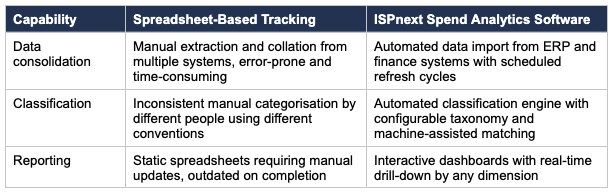
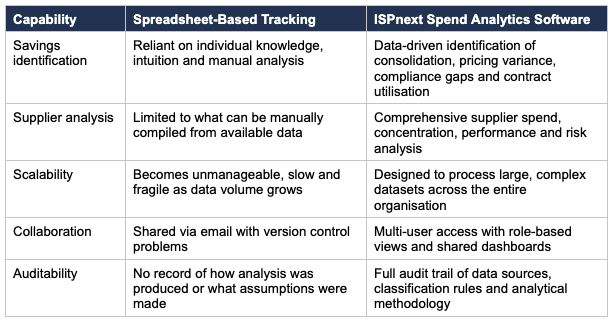
The Limitations of Spreadsheet-Based Spend Tracking
How ISPnext's Spend Analytics Software Works
Automated Data Collection and Integration
ISPnext connects directly to ERP and finance systems to import purchasing data automatically. This eliminates the manual extraction process that introduces errors and delays. Data can be imported from multiple source systems, consolidated and de-duplicated automatically, providing a single, clean dataset for analysis. Scheduled refresh cycles ensure that dashboards and reports reflect current spending patterns rather than historical snapshots.
Intelligent Classification
Raw purchasing data is classified into a structured taxonomy that enables meaningful analysis. ISPnext's classification engine uses configurable rules and machine-assisted matching to categorise transactions consistently, regardless of how they were recorded in the source system. This addresses one of the fundamental limitations of manual spend analysis: the inconsistency that arises when different people categorise the same type of purchase differently.
Interactive Dashboards and Drill-Down Reporting
The platform provides real-time dashboards with drill-down capability across every dimension: category, supplier, contract, department, cost centre, time period and geographic location. Visual reporting through charts, graphs and heat maps makes patterns and anomalies immediately visible. Users can start with a high-level view of total organisational spend and drill down to individual transactions, supplier invoices and contract line items.
Savings Identification and Opportunity Mapping
Spend analytics software identifies four primary categories of savings opportunity. Supplier consolidation: where the same category of spend is distributed across multiple suppliers, creating leverage for volume-based negotiation. Pricing variance: where the same goods or services are purchased at different prices across departments, locations or time periods. Compliance gaps: where spending occurs outside agreed contracts or procurement policies. Contract utilisation: where contracted volumes or spend levels have not been achieved, potentially affecting negotiated terms or rebate thresholds.
At Johnson Matthey, Athena Commercial applied structured spend analysis to achieve approximately two million pounds in savings through targeted negotiations with Dell, Cisco and Ivanti. At Block Solutions, a focused spend analytics exercise delivered a quarter of a million pounds in immediate savings with a further one million pounds identified through a comprehensive recommendation plan.
KPI Tracking and Benchmarking
The platform supports configurable KPIs that enable procurement teams to track and report on key performance metrics including cost per category, supplier concentration, contract compliance rate, savings achieved and procurement cycle time. Automated alerts notify users when KPI thresholds are breached, ensuring that performance issues are identified and addressed promptly.
Seamless ERP Integration
ISPnext's Spend Analytics Software connects with leading ERP systems including Microsoft Dynamics 365, SAP, JD Edwards, Infor and Exact Online. Standard integrations and the ISPnext API ensure automated data collection from source systems. This means spend dashboards are always current, always consistent with financial records and always available without manual intervention.
Spend Analytics Within the Broader Platform
Spend analytics provides the evidence base that informs every other procurement decision. It connects to sourcing software by identifying which categories should be sourced competitively, to vendor management software by revealing supplier concentration and performance patterns, to contract management software by tracking spend against contract values, and to procurement software by monitoring purchasing compliance. The integrated business spend management platform brings all modules together for complete visibility.
Athena's Implementation Approach
Athena Commercial delivers spend analytics through a consultancy-led implementation covering data source identification, extraction and consolidation, data quality assessment and cleansing, taxonomy design and classification rules, dashboard and report configuration, savings opportunity identification, user training and ongoing analytical support.
Our approach ensures that clients receive actionable insight from the first engagement, not just a configured platform. We combine technology implementation with hands-on analytical expertise, working alongside client teams to interpret the data, identify opportunities and develop action plans that deliver measurable savings.
For practical guidance on extracting value from spend data, read our blog: How Spend Analytics Software Unlocks Hidden Savings. See also our spend analytics services, our guide to the benefits of spend analytics in procurement and our article on the downsides of Excel for supplier spend management.
Frequently Asked Questions
What is spend analytics software?
Spend analytics software collects purchasing data from across the organisation, cleanses and classifies it using configurable taxonomies, and presents it through interactive dashboards and reports. It enables procurement teams to identify savings opportunities, monitor supplier performance, track KPIs and make data-driven decisions.
How does spend analytics save money?
Spend analytics identifies savings by revealing supplier fragmentation, off-contract spending, pricing inconsistencies and duplicate purchasing. It provides the evidence base for consolidation negotiations, contract renegotiations and sourcing strategy decisions. Typical savings range from five to fifteen per cent of addressable spend, depending on the organisation's starting maturity.
What data is needed for spend analytics?
The minimum dataset includes supplier name, invoice amount, date and category or description. Additional data such as contract reference, department, cost centre, purchase order number and payment terms enriches the analysis and enables more granular insight. ISPnext automates data collection from ERP and finance systems.
How long does spend analytics implementation take?
Athena Commercial targets operational delivery within one month for focused implementations. This includes data extraction, cleansing, classification, dashboard configuration and user training. Ongoing support ensures analytics remain current as the organisation's data landscape evolves.
Can spend analytics work with data from multiple systems?
Yes. ISPnext consolidates data from multiple ERP, finance and purchasing systems into a single, unified dataset. This is particularly valuable for organisations that have grown through acquisition or that operate different systems across business units or locations.
How does spend analytics differ from the reports in our ERP?
ERP reports typically show financial transactions at a line-item level. Spend analytics adds classification, aggregation, visualisation and analytical capabilities that transform raw transactional data into strategic procurement intelligence. The difference is between knowing what was paid and understanding what was purchased, from whom and whether it represented good value.
Is spend analytics a one-off exercise or an ongoing capability?
Both approaches have value. A one-off spend analytics exercise can identify immediate savings opportunities and establish a baseline. An ongoing capability, with automated data collection and refreshed dashboards, provides continuous visibility and supports sustained procurement improvement. ISPnext's platform supports both models.
Can spend analytics help us prepare for public sector frameworks?
Yes. Public sector frameworks increasingly require suppliers to demonstrate structured procurement practices and data-driven decision-making. Spend analytics provides the evidence base. Athena Commercial's framework registration services can help you leverage this capability in framework submissions.